2nm Architecture vs. Physical Constraints: An iPhone 17 Pro Technical Analysis
The iPhone 17 Pro represents a significant pivot in Apple’s hardware philosophy, prioritizing thermal conductivity and sensor volume over traditional aesthetics.
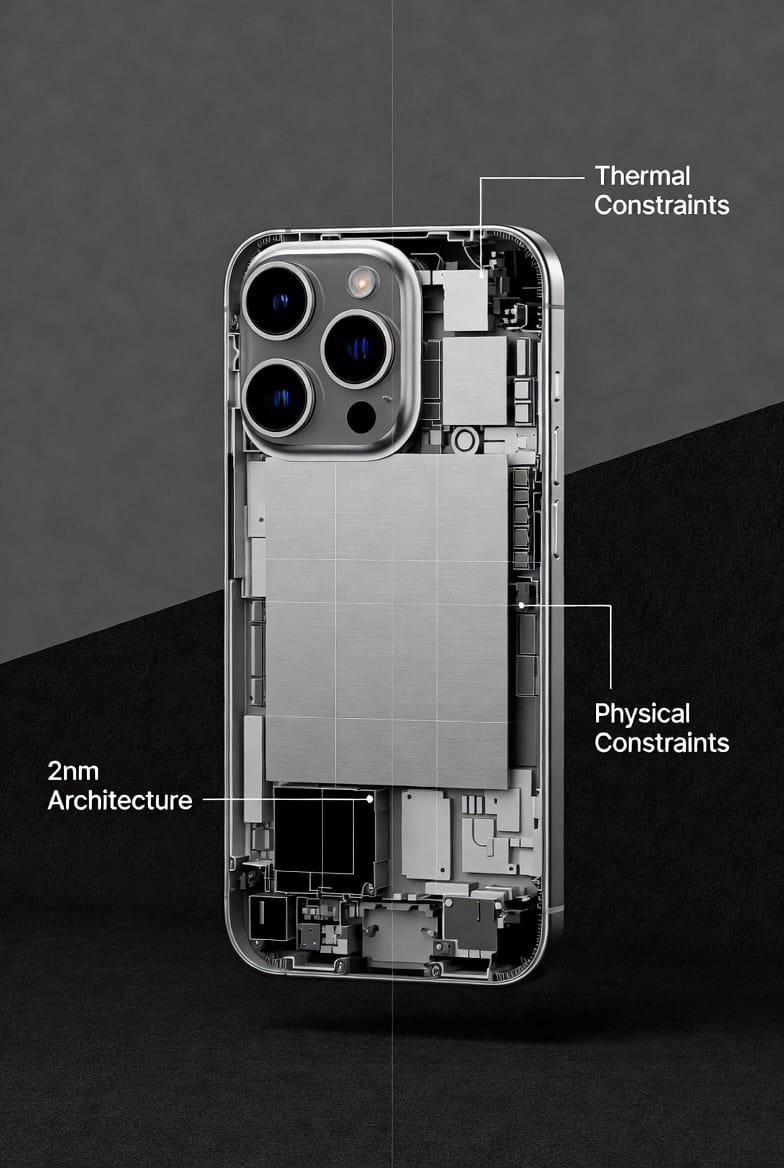
The release of the iPhone 17 Pro has sparked a high-level debate regarding Apple’s current hardware roadmap. While the A19 Pro SoC continues to push the boundaries of 2nm architecture and neural throughput, the physical implementation of the device has introduced several engineering trade-offs. From aggressive thermal management strategies to evolving computational photography pipelines, the 17 Pro is a study in balancing raw power with material limitations.
Thermal Engineering: The Aluminum Reversion
In a calculated move for the 2026 cycle, Apple transitioned the 17 Pro back to an anodized aluminum unibody, departing from the Grade 5 Titanium used in the previous two generations.
- The Logic: The A19 Pro chip generates significant heat during sustained peak loads. Aluminum’s thermal conductivity is roughly $200\text{ W/m·K}$, significantly higher than titanium’s ~$7\text{ W/m·K}$. This enables superior heat dissipation during intensive tasks like 8K ProRes video capture.
- The Trade-off: The return to aluminum has met criticism regarding surface durability. Specifically, the sharp-angled geometry of the new chassis has shown a higher propensity for anodization chipping at stress points. For many, this feels like a step back in material science for a "Pro" designated device.
The "Plateau" Architecture: Optical Arrays and Ergonomics
The most visible shift is the Plateau—a raised, horizontal optical bench that replaces the traditional square camera island with a singular, continuous elevation across the device’s Y-axis.
- Engineering Rationale: To accommodate the larger sensors required for the new 48MP telephoto array, Apple required increased internal volume. The Plateau provides a uniform deck for the triple-lens system.
- User Friction: The design has introduced a lateral weight imbalance. With the center of gravity shifted toward the top 25% of the chassis, users report increased wrist fatigue during one-handed operation. Additionally, the protrusion prevents the device from laying flush on X-Y planes, resulting in "table wobble" despite the broader base.
Computational Over-Processing: The "AI Slop" Phenomenon
Apple’s Image Signal Processor (ISP) and Neural Engine have never been more capable, yet the software’s interpretation of sensor data is a major point of contention.
- The Artifacting Issue: Users have identified a trend known as "AI Slop"—visible artifacts where the machine learning model "guesses" details in high-zoom scenarios. This often results in a "watercolor effect" or painterly texture in foliage and textiles, as denoising algorithms override raw sensor data.
- Lens Hunting: The handoff between the 48MP Wide and the 48MP Telephoto lenses in low-light environments (lux levels below 10) remains unoptimized. This results in "lens hunting," where the software flickers between sensors while seeking the best exposure-to-noise ratio, causing noticeable viewfinder lag.
The Dilution of the "Pro" Tier
For the first time, the technical gap between the "Air" and "Pro" models has narrowed to the point of friction for enthusiasts.
- Display Parity: The expansion of 120Hz ProMotion (LTPO technology) to the iPhone 17 Air has removed one of the strongest technical justifications for the Pro price point.
- The Aesthetic Gap: The decision to reserve the "Obsidian" (Black) finish for the Air model while offering only "Cosmic Orange" and "Deep Blue" for the Pro has frustrated users who prioritize a professional, minimalist hardware aesthetic.
Hardware Interface and Audio Fidelity
Early batches of the 17 Pro have faced scrutiny regarding the integrated speaker array and I/O performance.
- Acoustic Imbalance: Benchmarks show a frequency response discrepancy between the top earpiece and the bottom-firing speaker. Users report a "thinning" of low-end frequencies at volumes exceeding 80%, leading to an imbalanced stereo soundstage.
- Connectivity Intermittency: Despite the upgraded modem, some users are experiencing handshake failures with CarPlay and GPS drift in high-density urban areas. While likely a firmware issue within the initial iOS 19/20 builds, it remains a notable pain point for a flagship device.
The iPhone 17 Pro is an ambitious piece of hardware that prioritizes thermal efficiency and raw processing power. However, for those who value material prestige and "clean" photographic output, the current iteration represents a series of engineering compromises that have yet to be fully refined.