Blackwell Unleashed: Why the RTX 5090 is the Ultimate 2026 Powerhouse
CES 2026 just changed the game. The RTX 5090 isn't just a GPU; it's a 32GB monster capable of 6x AI frame generation and local LLM training that rivals data-center hardware. Here’s everything you need to know about the Blackwell flagship.
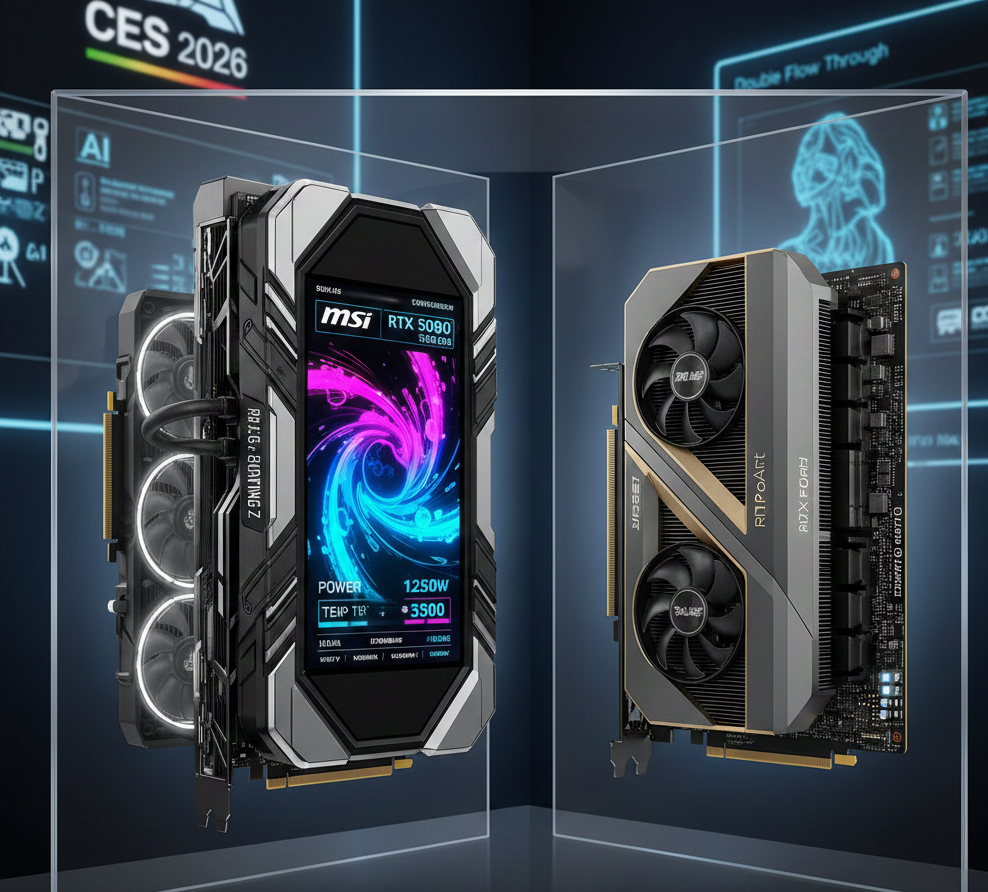
The dust has settled at CES 2026, and the message from the Las Vegas strip is clear: Silicon is hitting its stride. While rumors of a "Super" refresh were debunked due to global memory constraints, the existing RTX 5090 has solidified its status as a dual-purpose titan. Whether you are chasing 4K/480Hz path-traced glory or fine-tuning 30B parameter language models in your bedroom, the Blackwell flagship is the only card that matters right now.
1. DLSS 4.5: The "6x" AI Revolution
The headline software announcement of CES 2026 was DLSS 4.5. NVIDIA has moved beyond simple upscaling into what they call "Neural Immersion."
- 6x Multi-Frame Generation: Leveraging the 2nd Gen Super Resolution Transformer, DLSS 4.5 can now generate five frames for every one conventionally rendered frame. This effectively turns a 60 FPS base into a 360 FPS output, making 4K Ultra path-tracing feel like a low-latency eSports title.
- Dynamic Frame Generation: This new mode acts as an "AI Governor," automatically scaling frame generation to match your monitor's refresh rate (like the new 480Hz OLEDs) while minimizing power draw during less intense scenes.
2. LLM Training: A "Mini-DGX" on Your Desk
For the AI community, the RTX 5090’s 32GB of GDDR7 memory is the real star. With a 512-bit bus providing 1.79 TB/s of bandwidth, the 5090 isn't just faster than the 4090; it’s a different class of machine.
- Large Model Support: The 32GB buffer allows for local training and inference of 32B models (like DeepSeek-V3/R1) at high precision without the massive performance hit of offloading to system RAM.
- Blackwell Microscaling (FP4): The 5090 introduces native FP4 support, allowing researchers to run 4-bit quantized models with nearly zero accuracy loss, effectively doubling the "felt" VRAM compared to older FP8-only hardware.
3. The Custom Card Arms Race
Third-party manufacturers stole the show with designs that push the Blackwell architecture to its thermal limits.
MSI RTX 5090 Lightning Z: The 1600W Behemoth
After a long hiatus, the Lightning series is back. This card is a marvel of over-engineering, featuring:
- Dual 12V-2x6 Connectors: Required to feed its 1600W peak power delivery.
- 8-inch Full-Surface LCD: A built-in tablet on the shroud that displays real-time VRAM thermals, LLM token-per-second (TPS) counts, or custom animations.
- 40-Phase VRM: Designed specifically for world-record-breaking liquid nitrogen (LN2) overclocking.
ASUS ProArt: The SFF Champion
At the other end of the spectrum, ASUS proved that power doesn't always require a giant footprint. The ProArt RTX 5090 utilizes a "Double Flow Through" PCB design, making it SFF-Ready at just 2.5 slots. It’s the perfect choice for compact AI workstations that need to stay cool and quiet.
5090 vs. 4090: The Generational Leap
| Feature | RTX 4090 (Ada) | RTX 5090 (Blackwell) |
| VRAM | 24GB GDDR6X | 32GB GDDR7 |
| Bandwidth | 1.01 TB/s | 1.79 TB/s |
| AI TOPS | 1,321 | 3,352 (FP4) |
| DLSS Support | DLSS 3.5 / 4 | DLSS 4.5 (Exclusive 6x Gen) |
| TDP | 450W | 575W (Base) |
The RTX 5090 is no longer just a "gaming card." It is the first consumer-grade component that truly bridges the gap between enthusiast hardware and enterprise-level AI compute. While the power requirements are steep and the pricing remains in the "luxury" bracket, the 5090 represents the pinnacle of what’s possible in 2026.