Orchestration Over Autonomy: Resolving the Floor Bottleneck in Smart Factory Layouts
Building a smart robot is the easy part. The real challenge is making it communicate. We break down the complex reality of industrial factory orchestration.
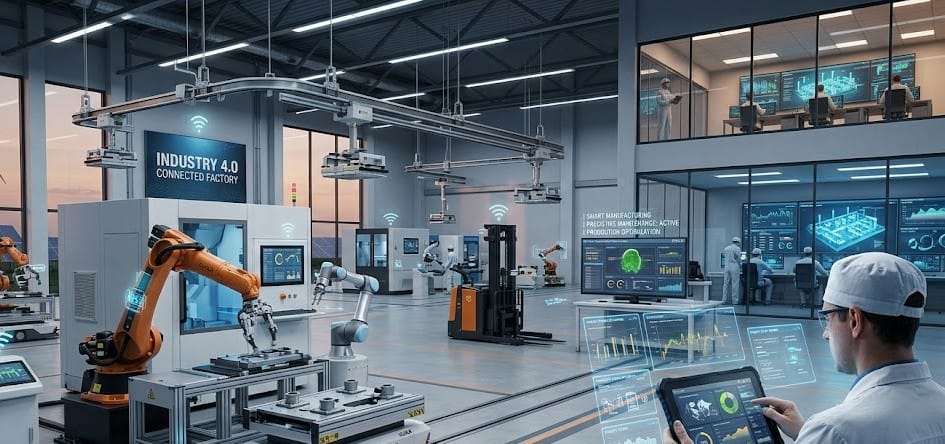
For the past decade, the marketing narrative surrounding factory automation has been heavily hyper-focused on individual machine autonomy. Robot manufacturers love to showcase sleek, multi-axis articulated arms using advanced computer vision to sort parts at lightning speeds, or autonomous mobile robots (AMRs) deftly navigating crowded warehouse floors without human intervention. But if you talk to systems engineers down on the actual plant floor, they'll tell you that buying a smart robot is no longer the hard part. The real, high-stakes engineering bottleneck is orchestration—getting separate islands of high-tech automation to reliably talk to one another and synchronize with legacy manufacturing infrastructure.
In a typical modern factory layout, you are almost never building a clean-sheet system from scratch. Instead, you are tasked with dropping a state-of-the-art edge AI sorting cell right into a production line driven by a twenty-year-old Programmable Logic Controller (PLC) and a legacy Manufacturing Execution System (MES). These subsystems speak entirely different communication languages. The new AMR fleet might operate on an agile, cloud-managed ROS 2 framework, while the main conveyor line relies on deterministic, legacy industrial protocols like Profinet or EtherCAT. If these data layers aren't perfectly bridged, your highly advanced robots will spend half their operational cycles idling, waiting for a basic handshake signal that never arrives.
Resolving this floor bottleneck requires a shift in engineering priorities from physical machine performance to unified middleware orchestration layers. Factory architects are increasingly leaning into open, platform-agnostic middleware standards to build a centralized data fabric across the facility. This allows a robotic cell to not only see the part directly in front of its optical sensor, but also monitor the upstream inventory status and downstream packing queue in real time. True automation efficiency isn't achieved by making an individual arm move 10% faster; it's achieved by engineering an integrated digital nervous system that eliminates communication lag across the entire facility floor.