The Rise of the Machine: Why Atlas is the "Final Boss" of Industrial Robotics
As Boston Dynamics takes the electric Atlas into production, it faces its toughest rivals yet. We break down how the hyper-rotational powerhouse stacks up against Tesla’s Optimus and Figure 02 in the race for industrial dominance.
The neon lights of Las Vegas aren't just for show this year. At CES 2026, the conversation has shifted from "can a robot walk?" to "how much can a robot work?" Leading the charge is the production-ready electric Atlas, a machine that marks the end of Boston Dynamics’ research phase and the beginning of its industrial empire.
But the factory floor is getting crowded. With Tesla’s Optimus Gen 3 aiming for your home and Figure 02 chatting its way into warehouses, the battle for humanoid supremacy has officially begun.
The Contenders: Three Visions of the Future
While they all share two legs and two arms, these robots are built for entirely different lives.
1. Boston Dynamics Atlas: The Hyper-Rotational Workhorse
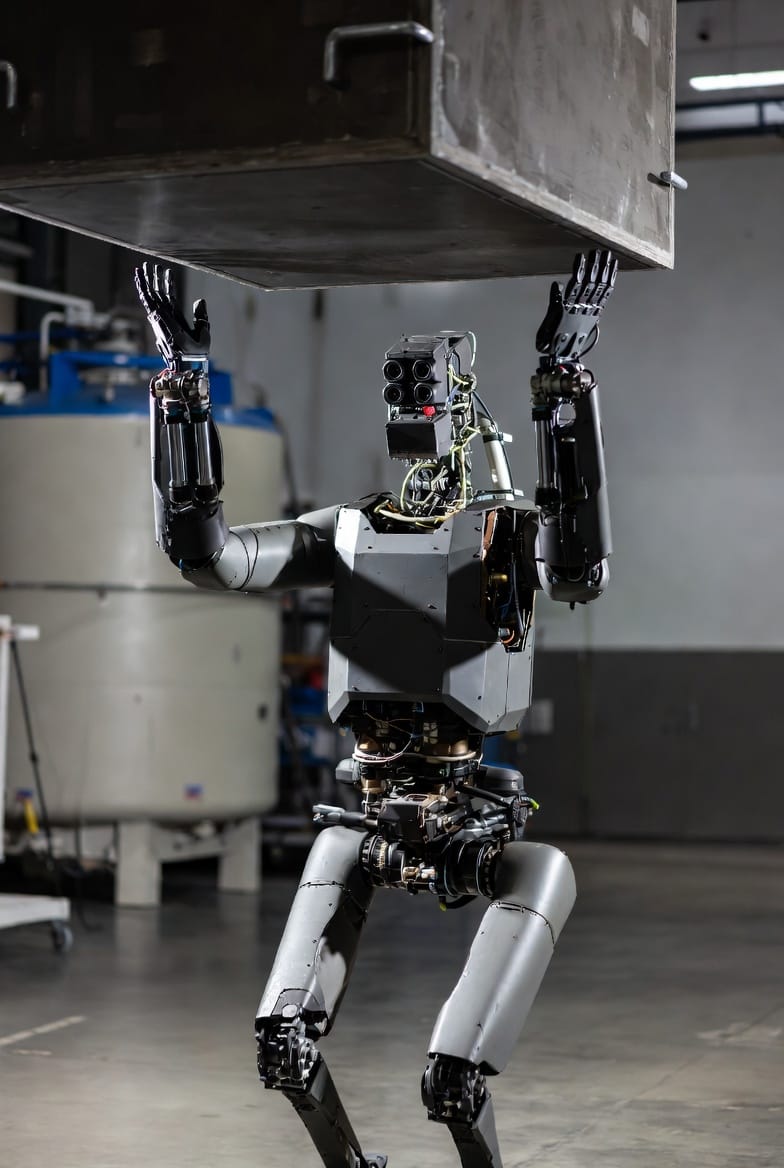
Boston Dynamics has traded its hydraulic "gymnast" for an electric "powerhouse." The new Atlas is designed for tasks humans can't do efficiently.
- The Secret Weapon: 360-degree rotational joints. Atlas doesn't need to turn its body to walk backward; it simply flips its head and torso around.
- Target: High-stakes industrial manufacturing (starting with Hyundai’s car plants).
2. Tesla Optimus (Gen 3): The Scalable Citizen
Tesla is playing the volume game. Leveraging the same AI that drives their cars, Optimus is being built as a general-purpose assistant.
- The Secret Weapon: Scale and integration. Tesla aims to bring the price down to roughly $20,000–$30,000, making it the "Model 3" of robots.
- Target: Logistics, light assembly, and eventually, your living room.
3. Figure 02: The Intellectual Generalist
In partnership with OpenAI, Figure 02 is the most "human-like" in its communication. It doesn't just perform a task; it understands your verbal instructions.
- The Secret Weapon: Speech-to-speech reasoning. Thanks to its "Helix" AI stack, it can explain why it’s picking up a specific box while it does it.
- Target: Commercial pilots in warehouses (like BMW) and high-dexterity assembly.
Head-to-Head: The Spec Sheet
| Feature | Electric Atlas | Tesla Optimus (G3) | Figure 02 |
| Lift Capacity | 110 lbs (50 kg) | ~45 lbs (20 kg) | ~55 lbs (25 kg) |
| Mobility | Hyper-Rotational (Non-human) | Anthropomorphic (Human-like) | Anthropomorphic (Human-like) |
| AI Brain | Google DeepMind / Orbit | Tesla FSD / Grok | OpenAI / Helix VLM |
| Battery Life | Variable (Auto-Swap Capable) | ~8–10 Hours | ~5 Hours (Hot-Swappable) |
| Vibe | Industrial Precision | Mass Market Consumer | High-End Tech Assistant |
The Big Shift: From "Think" to "Act"
The most significant trend at CES 2026 is Physical AI. We are moving past chatbots and entering the era of "Agentic Robotics."
Atlas stands out here because it doesn't try to be human. By using fully electric actuators and a body that can twist in ways that would break a human spine, it solves the "maneuverability problem" in tight factory spaces. While Optimus and Figure 02 are learning to navigate our world, Atlas is busy redefining how a factory can be built around a robot.
If you need a robot to fold your laundry and talk to your kids, Tesla and Figure are winning that race. But if you need a machine to move 100-pound engine blocks in a 104°F factory for 20 hours a day, Atlas is in a league of its own.
The humanoid wars aren't about who looks the most like us anymore—they're about who can do the work we no longer want to do.