Comparing Flexible Circuit Interconnects: Technical Tradeoffs Between FFC Connector, FPC Connector, and FPC Cable Implementations
Demystify flexible circuitry hardware. Discover when to deploy an FFC connector versus a precision FPC connector and custom FPC cable for low-profile electronics.
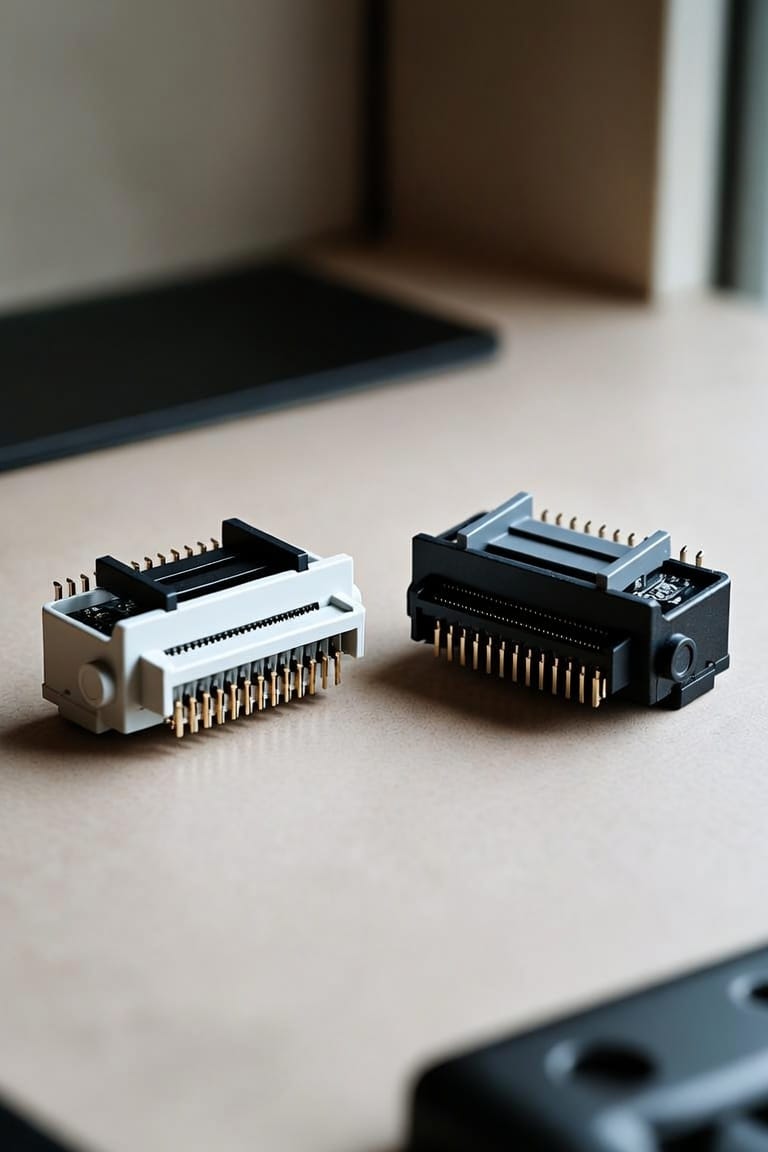
Modern consumer electronics, medical diagnostics, and automotive infotainment systems share a common design restriction: highly constrained internal spatial profiles. To navigate complex three-dimensional enclosures while maintaining low weight and reliable data paths, design teams rely heavily on flexible circuitry. When implementing these solutions, engineers must choose between flat flexible cables (FFC) and flexible printed circuits (FPC), paired with their respective ffc connector and fpc connector interfaces. Choosing the correct approach requires balancing cost, circuit complexity, and mechanical durability.
Flat Flexible Cables (FFC) are composed of flat, rectangular copper conductors laminated between two thin layers of insulating polyester or polyimide films. These cables are linear, uniform, and ideal for straightforward point-to-point connections. An ffc connector is typically a surface-mount or through-hole socket soldered onto a rigid PCB designed to accept the stripped, reinforced end of an FFC. Key attributes include: Cost Efficiency—FFC production is highly automated and linear, making it incredibly economical for high-volume consumer goods like printers, display screens, and appliances. Pitch Options—commonly available in standard metric pitches including 0.5mm, 1.0mm, and 1.25mm. Simplicity—because the internal copper conductors run completely parallel, FFCs are limited to simple point-to-point signal routing without crossing lines or integrating surface-mount components directly onto the cable.
When an application demands complex, non-linear circuit routing, high-density component placement, or strict impedance matching, standard FFCs fall short. This is where a dedicated fpc cable (Flexible Printed Circuit) and its matching fpc connector interface become necessary. Unlike a laminated FFC, an FPC is a fully customizable, photolithographically etched circuit manufactured on a flexible polyimide substrate. This allows an FPC to behave exactly like a flexible, ultra-thin multi-layer PCB. The core advantages include: Complex Trace Geometries—traces on an FPC can bend, narrow, widen, split into multiple branches, and cross over each other via internal layer connections. Component Integration—active and passive surface-mount devices can be soldered directly onto the flexible circuit substrate. High-Density Packaging—an FPC socket interface can achieve ultra-fine pitches down to 0.2mm or 0.3mm, featuring dual-sided contacts and zero-insertion-force (ZIF) or low-insertion-force (LIF) flip-lock actuators.
When deciding which flexible interconnect architecture to specify for a project, engineering teams must evaluate spatial constraints, budgetary limits, and dynamic flexing requirements. If your device requires ultra-fine pitches and a connector profile height under 1.0mm, an FPC layout is superior. For straightforward, linear data connections between two parallel boards where spatial constraints are moderate, an FFC assembly offers massive cost savings. Finally, in applications featuring moving components like a camera lens zoom or a folding laptop hinge, custom-designed FPCs offer superior fatigue resistance over hundreds of thousands of flex cycles.