High-Density Floating Board-to-Board Connectors: Optimizing Stack Height and Pin Count for Modern Electronics
More pins, less space, more problems. Learn how to optimize 120+ pin counts and stack heights using high-density floating board-to-board connectors in 2026.
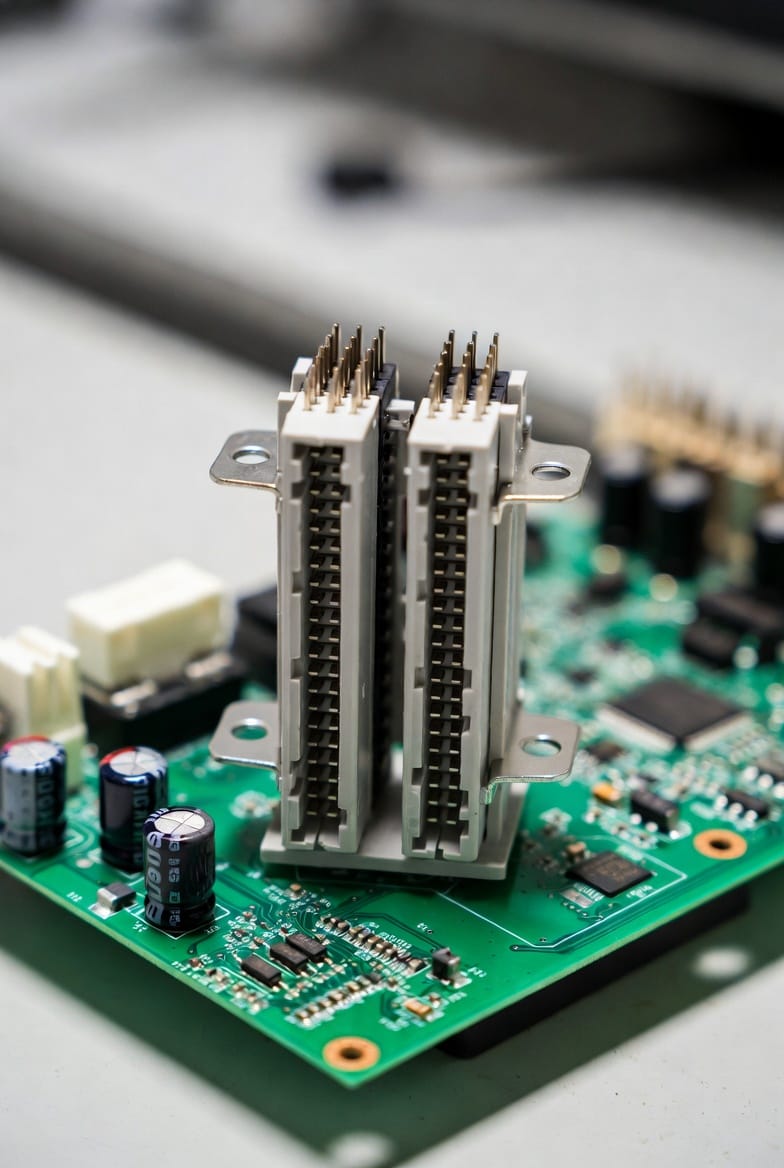
Modern hardware is experiencing a "Density Explosion." We are seeing AI-accelerator modules and cockpit compute units that require 120 to 140 pins squeezed into a 0.50mm or 0.40mm pitch. When you combine this density with a Floating Mechanism, you are dealing with one of the most complex mechanical components on your PCB. Managing the relationship between pin count, stack height, and mating force is critical for a 2026-grade design.
The Mating Force Challenge
Every pin in a connector requires a certain amount of "Insertion Force" to mate—usually around 0.3N to 0.5N per pin.
- The Math: A 140-pin connector can require up to 70 Newtons of force to fully seat. On a 0.8mm thick PCB, that amount of pressure can cause the board to flex, leading to "solder joint fatigue" or even cracking of nearby SMT components like MLCCs.
- The Floating Advantage: High-density floating connectors are designed with a "Sequential Mating" profile. The terminals are slightly staggered in height so they don't all engage at the exact same millisecond. This spreads the 70N force over a longer "travel distance," protecting the PCB from sudden mechanical shock.
Optimizing Stack Height (The Z-Axis)
Stack height is the distance between the two parallel PCBs. In high-density designs, this is a delicate balance.
- Short Stacks (3mm to 6mm): These are ideal for high-speed signal integrity. A shorter terminal has lower inductance and less crosstalk. However, the "Floating Range" is restricted. If your boards are large (like a server motherboard), a 4mm stack might not have enough "play" to compensate for PCB warpage.
- Tall Stacks (10mm to 20mm): These allow you to clear tall components like heat sinks or inductors on the bottom board. Because the terminals are longer, they can offer a much larger floating range (up to ±0.8mm). In 2026, tall floating connectors are becoming the standard for automotive "stacked" ECU designs where thermal management requires significant airflow between the boards.
Pin Count vs. Alignment
It is often better to use two 60-pin floating connectors rather than one massive 120-pin unit. Why? Even with a floating mechanism, a 120-pin connector has a very wide footprint. If there is a "twisting" or "angular" misalignment, the pins at the extreme ends of the connector will be stressed more than the ones in the center. By splitting the pin count, you allow each connector to independently self-align, significantly increasing the reliability of the system.