PCIe Gen 6 and CXL: The AI Era’s Crucial High-Speed Handshake
Massive processor clusters are useless if they spend half their time waiting for data. Let's look at how PCIe Gen 6 and Compute Express Link (CXL) are fixing the data bottleneck.
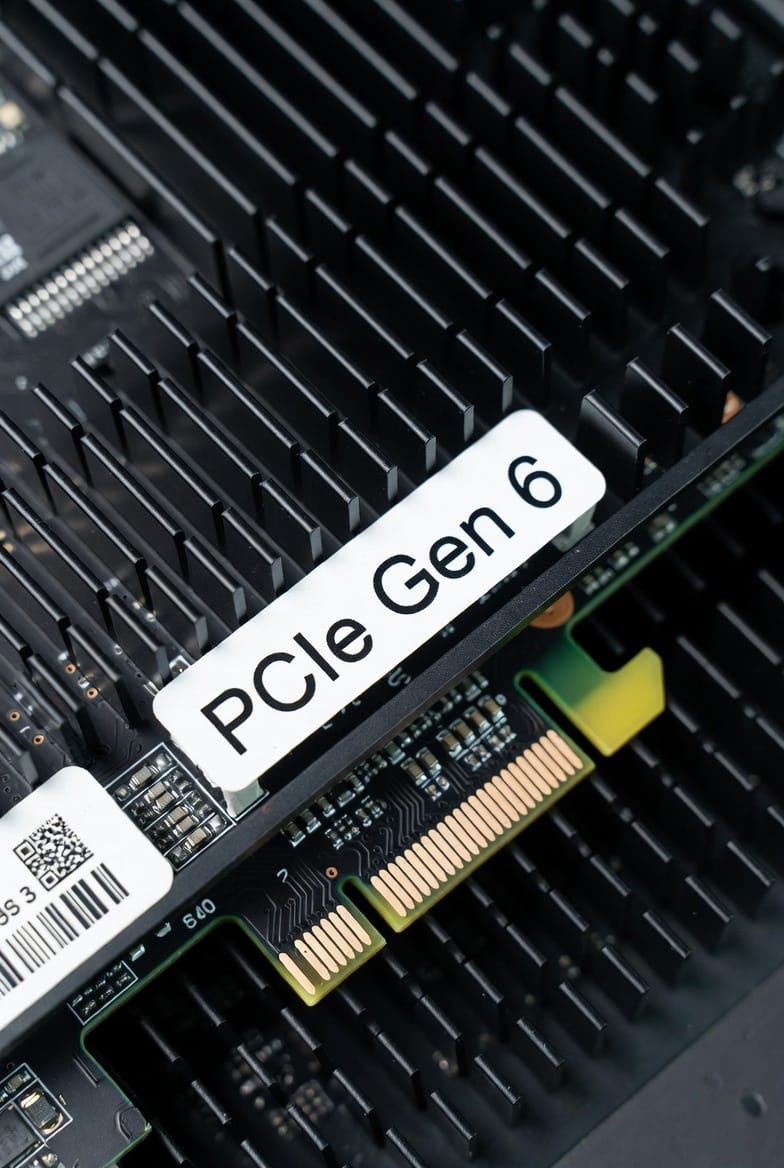
We talk a lot about massive GPUs and brain-like AI models, but the quiet hero of the AI era is the physical copper and optical lanes keeping them fed. As machine learning clusters scale, traditional data pipelines are choking on their own transfer rates.
The industry’s answer is a powerful physical and architectural double-whammy: PCIe Gen 6 and Compute Express Link (CXL).
Why PAM4 Changes Everything
By transitioning from binary NRZ (Non-Return-to-Zero) signaling to PAM4 (Pulse Amplitude Modulation with 4 levels), PCIe Gen 6 successfully doubles the bandwidth of its predecessor, delivering up to a massive $256\text{ GB/s}$ of bi-directional throughput on a standard x16 slot.
NRZ Signaling (2 levels: 1 bit per cycle)
─── High (1) ───
─── Low (0) ───
PAM4 Signaling (4 levels: 2 bits per cycle)
─── Level 3 (11) ───
─── Level 2 (10) ───
─── Level 1 (01) ───
─── Level 0 (00) ───
Because PAM4 packs 2 bits per clock cycle into four distinct voltage levels, the signal is much more sensitive to noise. To combat this, PCIe Gen 6 introduces mandatory FLIT (Flow Information Unit) packaging and a lightweight FEC (Forward Error Correction) algorithm, ensuring transmission integrity without adding noticeable latency.
CXL: Eliminating the GPU "Tax"
CXL sits directly on top of this physical PCIe Gen 6 layer to solve the memory bottleneck. Traditionally, if a GPU ran out of its dedicated, expensive VRAM, it had to slow down to a crawl to page data from the system's main RAM.
CXL 3.0 allows the CPU, GPU, and dedicated external memory expanders to share a unified, coherent memory space. Instead of copying blocks of data back and forth over a sluggish system bus, the GPU can access pooled DRAM modules in real-time with sub-microsecond latency. This turns raw physical interconnects into a dynamic, scale-out memory fabric.